
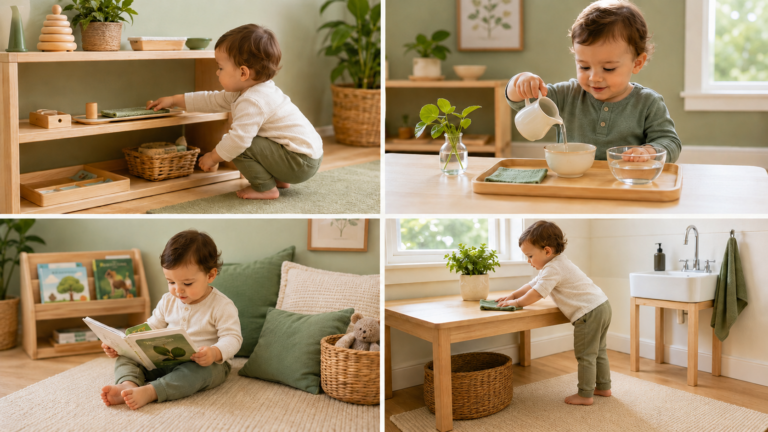
Between 12 and 24 months, many children become more mobile, curious, and eager to participate in daily life. They may be walking more steadily, climbing, carrying objects, exploring with their hands, and beginning to communicate more clearly.
A Montessori approach at this stage focuses on safe movement, independence, practical activity, language development, and hands-on exploration.
Please note: This article is for general information only and is not a substitute for medical, developmental, safety, feeding, or sleep advice. Always follow current child safety guidance and speak with your child health nurse, paediatrician, or qualified professional if you have concerns about your child’s development or wellbeing.
Montessori Development from 1–2 Years
During this stage, children often gain more control over their bodies. As they become more stable on their feet, their hands are freed for carrying, building, opening, closing, drawing, sorting, and practical life activities.
Children at this age may want to climb, push, pull, carry, insert objects, empty containers, and repeat actions many times. These behaviours are often signs of development, curiosity, and growing coordination.
The goal is not to stop exploration, but to create safe opportunities for movement and discovery.
Montessori Environment for 1–2 Years
At this age, the home environment may need to be reviewed again. A child who can stand, walk, and climb has a much higher reach than before. This means safety and accessibility become even more important.
The room should allow movement while also reducing avoidable risks. Sharp objects, unstable furniture, cords, small objects, and breakable items should be kept safely out of reach.
Simple Environment Ideas
- Create a safe movement area where your child can walk, crawl, carry, and explore.
- Use low shelves with a small number of accessible materials.
- Provide a child-sized table and chair for snacks, simple activities, and practical work.
- Keep toys and materials organised in baskets or trays.
- Offer safe opportunities for climbing, carrying, pushing, and pulling.
A child-sized table and chair can be especially useful at this stage. It gives the child a clear place to eat snacks, draw, explore materials, or complete simple activities.
Outdoor Movement and Climbing
Outdoor time can be very beneficial for children aged 1–2 years. They often need space to move, climb, run, balance, and test their developing gross motor skills.
Safe outdoor opportunities may include:
- Low climbing structures
- Grass or soft surfaces for running and movement
- Low swings used with supervision
- Push toys or wagons
- Simple opportunities to carry, collect, and explore natural objects
Children may trip or fall as they learn to move more confidently. With appropriate supervision and a safe environment, small challenges can help children build coordination, confidence, and resilience.
The aim is to guide from a short distance when safe, rather than constantly interrupting their movement.
Montessori Materials and Toys for 1–2 Years
At this stage, children are developing stronger hand-eye coordination and more purposeful movement. They often enjoy materials that allow them to grasp, place, stack, insert, open, close, draw, and repeat actions.
Simple materials are usually best. Choose items that are safe, durable, and suited to your child’s current ability.
Simple Wooden Puzzles
One- or two-piece wooden puzzles can be a good starting point. These allow the child to practise matching, grasping, and placing pieces successfully.
Choose puzzles that offer a small challenge but are not too difficult. The goal is for the child to succeed with effort, not become frustrated by materials that are beyond their stage.
Stacking Rings and Shape Materials
Rings of different sizes placed onto a base can support coordination, visual discrimination, and problem solving.
At first, the child may simply enjoy removing the rings. Over time, they may begin to place them back on the base and notice differences in size.
Wooden Blocks
Wooden blocks are simple, open-ended, and long-lasting. At first, children may enjoy watching an adult build and then knocking the tower down.
Later, they may begin stacking blocks themselves. Blocks do not need to be only cubes. Different shapes can encourage creativity and exploration.
Drawing Materials
A large crayon or block crayon with paper can be introduced when your child is ready.
You may place the paper on a small tray to help define the drawing space and make clean-up easier. A darker tray can also help the paper stand out visually.
As your child develops, you may introduce other safe art materials such as thick non-toxic markers or coloured pencils. Show your child how to use them gently and how to keep drawing on the paper.
Posting and Drop Boxes
Drop boxes with balls or simple shapes can support grasping, hand-eye coordination, and intentional release.
These activities are often very engaging because the child can repeat the action again and again.
Rings and Dowels
A simple dowel with a stable base can be used with safe ring-shaped objects. Children at this age often enjoy placing rings onto a post and removing them again.
Always ensure materials are large enough to be safe and suitable for your child’s age and stage.
Opening and Closing Activities
Many children aged 1–2 years are interested in opening and closing. A basket with safe containers, small bags, Velcro, snaps, or simple lids can support this interest.
As the child becomes more skilled, you may introduce slightly more challenging containers, such as screw-top bottles, if they are safe and appropriately sized.
Language Development from 1–2 Years
During this stage, children are learning to communicate more intentionally. Some may say their first clear words around this period, while others may take longer. Receptive language — what the child understands — is often more advanced than expressive language — what the child can say.
A Montessori approach encourages adults to speak clearly, respectfully, and naturally to the child.
Ways to Support Language
- Talk to your child, not only at your child.
- Describe what you see, hear, and do during daily routines.
- Use books, songs, and rhymes to build vocabulary.
- Speak slowly and clearly so your child can hear the sounds of words.
- Name objects before handing them to your child.
- Use specific language, such as “red rose” instead of only “flower”.
It can also help not to anticipate every need immediately. When safe and appropriate, give your child time to gesture, vocalise, or attempt a word.
If your child points or makes a sound for something they want, you might gently name the item before giving it to them. For example: “Water. You want water.”
Common Language Interests at This Age
- Animals and animal sounds
- Food
- Body parts
- Transport
- Everyday household objects
This is also a good time to model simple manners such as “please” and “thank you”, without forcing or pressuring the child to repeat them perfectly.
The Montessori Three Period Lesson
Maria Montessori used a simple method for teaching vocabulary called the Three Period Lesson. For young children, this is best done gently, using real objects and without pressure.
You might use three familiar objects, such as fruits, vegetables, clothing items, utensils, or realistic animal figures.
Place the objects on a mat, tray, or small table where your child can see and touch them.
First Period: Naming
In the first period, introduce the object.
For example:
“This is an apple.”
Let the child touch, hold, and explore the object if appropriate. Then repeat the name.
This helps create a concrete memory because the child is connecting the word with a real experience.
Second Period: Recognising
In the second period, ask the child to identify the object.
For example:
“Can you show me the apple?”
You can move the objects around so the child learns the name of the object, not just its position.
This stage can be made more active by asking the child to place the object in a basket, hand it to you, or move it to another spot on the mat.
You can also introduce simple position words, such as:
- in
- on
- behind
- in front
- next to
Third Period: Remembering
In the third period, the child is asked to name the object.
For example:
“What is this?”
This stage is usually more suitable for children who are already speaking more confidently. There is no need to rush this step. If the child is not ready, simply continue naming and recognising objects in a relaxed way.
Practical Life at 1–2 Years
Children in this age range often want to participate in everyday life. Practical life activities are simple real tasks that help children feel capable and connected to the family.
Simple Practical Life Ideas
- Wiping a small table
- Putting clothes into a laundry basket
- Carrying a small object from one place to another
- Helping place napkins on the table
- Putting toys or materials back into a basket
- Practising with a spoon, cup, or small bowl
These tasks should be simple, safe, and offered without pressure. The aim is participation, not perfection.
Key Takeaways
From 1–2 years, Montessori at home is mainly about safe movement, independence, practical activity, language, and simple hands-on materials.
- Provide safe opportunities for walking, climbing, carrying, and exploring.
- Use low shelves and simple baskets to support order and independence.
- Offer materials that match your child’s current abilities.
- Speak clearly and naturally to support language development.
- Use the Three Period Lesson gently with real objects.
- Invite your child to participate in simple practical life tasks.
At this stage, Montessori is not about rushing your child or creating a perfect environment. It is about observing your child, offering the right level of support, and creating safe opportunities for independence to grow.